

Waist-Deep in Congo’s Lango Bai

Picking up where we left off last week…From Ngaga, we drove back west and traded our game viewer for kayaks as we embarked on a river journey downstream along the Lekoli River. The slower pace allowed us to find and view the shy de Brazza’s monkey as well as the bizarre looking black-and-white colobus and an abundance of palm nut vultures. We also had our first sightings of forest buffalo, including one individual that happened to be waiting for us right at the point where we tied up our kayak’s and continued our journey on foot.

On foot, we waded through shallow water that marked the beginning of the Lango Bai complex, a network of connected wetlands and clearings surrounded by forest—a habitat quite unique to this part of Africa. The water in these bais is mineral rich and so attracts various forest species. Amongst these are forest elephants. Just before we got to Lango camp, we encountered a forest elephant bull coming down for a drink. Seated quietly a distance away, we had a great view as he used his trunk to blow air into the soil beneath the water, likely to stir up sediment and increase access to dissolved minerals and salts. A slight change in the wind direction brought him our scent and his behaviour quickly changed as he tried to identify our scent and location. Not wanting to disturb him, our guide Joe did a great job of navigating us around him and we continued our walk into camp, just in time to catch the sunset.
Viewing a forest elephant bull coming down to the 'bottleneck' for a drink
Walking through Lango Bai (left) and the bai complex from above (right, photo courtesy of Kamba)
Lango Camp is a superb little bush camp set on raised stilts with a boardwalk high above the ground with all rooms facing the bai itself. The camp is excellent for birding and we had great views of a blue malkoha just in front of our room.
Lango Camp (left) and a blue malkoha in front of our room (right)
The next morning, we woke up early to depart camp before sunrise to look for forest elephants in the bai before they would inevitably disappear into the forest for the day. We got lucky with a bull near a herd of forest buffalo and were able to view both really well.

We continued our walk into the forest, focusing on smaller details such as some bongo tracks and thousands of termites on a dead tree. We also came across a secretive chocolate-backed kingfisher smacking a small beetle off a branch—a lifer for both Jomi & Hadley.

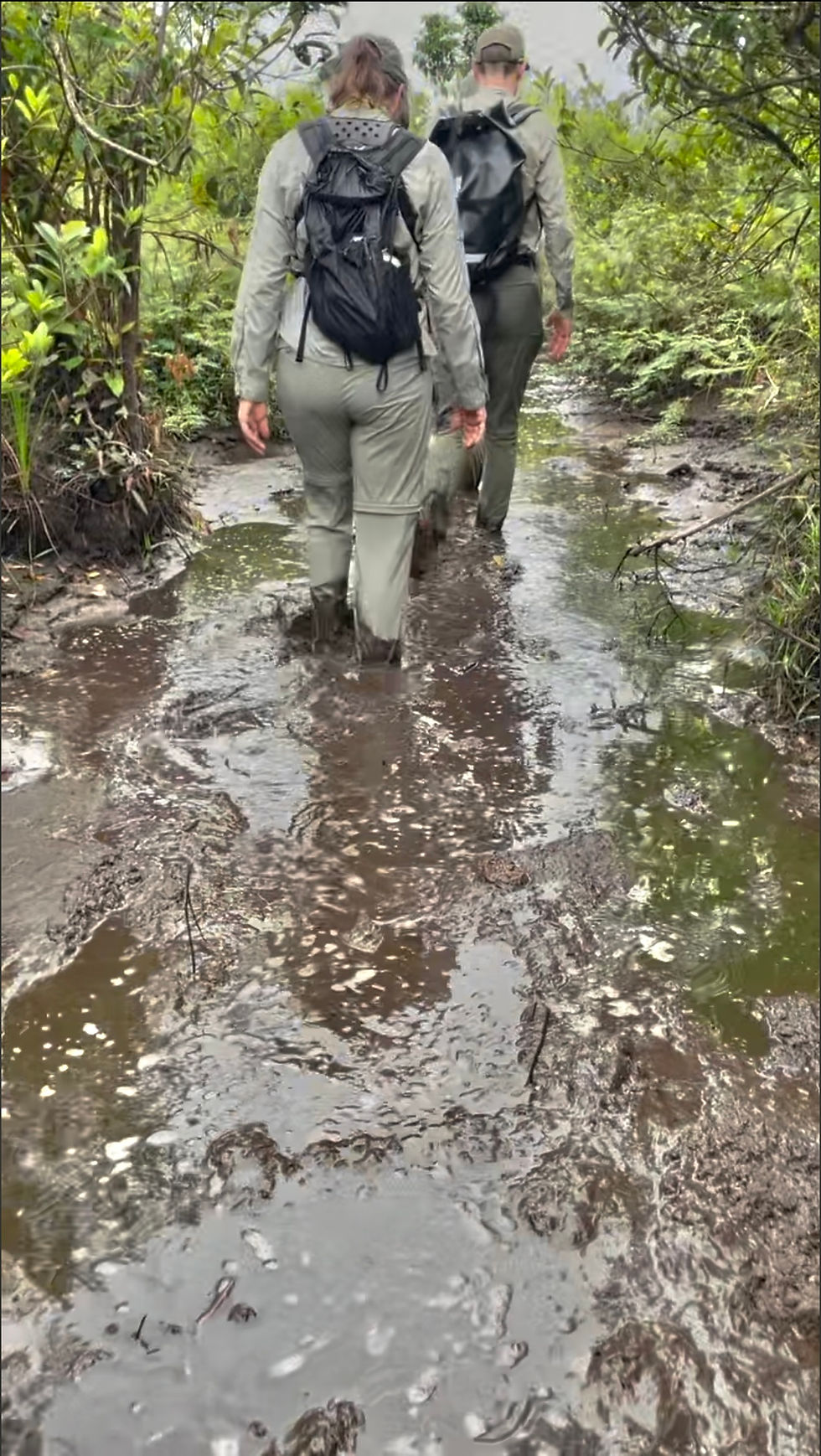
As we left the forest, we found ourselves walking through a stream of standing water, which turned into stagnant water, which turned into muddy, smelly stagnant water that we then decided to dub Schitt’s Creek, named after the fetid hippo and elephant dung marinating in the sun on the water’s surface. Needless to say, the second we got back into the clearer bai water, we scrubbed off all the Schitt’s Creek sediments. A different kind of sensory experience…
On our walk back to camp, we saw our first flock of African Green Pigeon which this area is known for. Its iconic ‘Tarzan’ call was one we heard regularly over the next few days.

In the afternoon, we relaxed around the bai, sitting in the water while having a drink and watching the sun going down. It was a great way to slow the pace of the trip down for an afternoon.

In the evening after dinner, we left camp in a game-viewer and drove into the nearby savanna. After just ten minutes or so we came across a group of hyenas, which had just departed their den and were making their way down towards the bai to hunt. Spotted hyenas are Odzala’s largest terrestrial predator (with lions having gone regionally extinct back in the 1990s) and there were some enormous females in the group as well as several youngsters that were very curious about the vehicle. We viewed this clan for about half an hour as they lay in the road, nursing, vocalizing, bickering with each other, and anal-pasting, a lovely activity whereby a dark paste is secreted from an anal gland and ‘displayed’ on a strand of grass or bush in order to help them determine hierarchy, sexual status, territory and more. Nature’s social media, you could say.

Upon returning to camp, we were able to use the camp’s infrared night camera to view some of the bai’s nocturnal visitors. A genet came past on its prowl, hunting moths and frogs as did several forest elephants who eventually interacted with the spotted hyena that also showed up.
The following morning was slightly foggy and overcast and we departed camp a bit later in order to get views of the various flocks of African Grey Parrots flying over the bai, constantly vocalizing. The main part of the walk though consisted of us walking through two ancient elephant paths that led straight through a wetland next to the bai. This involved being waist deep in water and so we walked slowly. The silence of the swamp along with the knowledge that these paths have been walked by elephants for potentially thousands of years made for a humbling experience and one of our favourite experiences of the trip.
African grey parrots in flight (left) and our group wading through the ancient elephant-made channels
That afternoon, we walked into a slightly different area, staying very close to camp. We came across a very old elephant skull, unique because it only had one tusk socket. The bai complex is fed by a series of tributaries that merge in a wooded area, and we followed these back towards the camp, sometimes swimming, sometimes wading. The feeling of being in the water while enclosed by the canopy of the trees was magical, and it felt like we were in a fairytale as we meandered back to camp.
Walking the bai's wooded 'tributaries' (left) and the one-tusk-socketed elephant skull (right)
On our last morning, we decided to go out with a bang. After an early morning departure from camp, we came across an elephant bull in the reeds and we watched him feeding as the sun rose. We followed this incredibly peaceful scene up with a truly rambunctious event: the swamp race. This was a 50m or 150ft ‘dash’ through a particularly deep and muddy section of swamp. A few steps in and everyone was covered head to toe in mud. We were eventually basically swimming in mud, with mud in our ears and other body parts by the end…This was not a typical guest activity, but our guides (perhaps sensing our adventurous—and competitive?—spirit) challenged our group to complete the swamp race. It really brough out the inner child in each of us and this is something that happens regularly when spending time in Odzala and something we will talk about more on next week’s episode, where we head to our final camp: Mboko. Join us again next week!
The swamp race: a messy affair


Comments