

The Secretive Creatures of the Congo Rainforest

We continue our journey in Congo’s Odzala-Kokoua National Park. This time, at our last lodge of the trip: Mboko. On our first afternoon at Mboko, we explored the Lekoli River by boat, which was another new method of transportation for the trip. The aluminum bottom speedboat allowed us to travel much further down the river than previously, and we had some great views of Cassin’s flycatcher followed by a breeding herd of buffalo with youngsters hanging out on the water’s edge.


We eventually stopped on a sandbank for a sundowner, which happened to be next to a bai. The sun was already setting, and as we sipped our G&Ts, a herd of forest elephants came down to the bai for a drink and a dust bath. This was our first breeding herd in Odzala and it was split into two small family groups with a couple of adult females and youngsters. While they drank, we observed them from a safe distance away. Eventually, the wind seemed to change and the whole herd lifted their trunks, caught a whiff of our scent, and moved off into the forest again.

The following morning, extremely early, we took to the boat again and this time headed upriver. As we rounded a bend in the river, we literally couldn’t believe our eyes and collectively gasped: a big male bongo was staring straight back at us from the edge of the river. These forest antelope are massive with a large male weighing easily 700 lbs. They are a gorgeous orange colour and the males have incredible spiral shaped horns. What made the sighting so special is that they are extremely rare to see; bongos are as shy as they are elusive and tend to move away when they sense human presence. This bongo did not seem overly bothered by us and allowed to us to view him for about half a minute before he disappeared slowly and silently back into the forest. The energy in our group after this sighting was palpably high.

We parked the boat and continued the journey on foot and immediately found the track of a large solitary male chimpanzee, another sign of a very elusive forest resident. Chimpanzees in this area are not habituated to the presence of humans and so they are very rarely seen (though not infrequently heard). The knowledge that one had passed by here not too long ago really added to our feeling of wonder and awe. The forest just holds so many secrets.

We walked along streams and tributaries of the river up into another bai system, stumbling across another small group of forest buffalo. We used the forest around the bai as cover, popping out at various points around the bai network to check if other animals were around. At the next ‘viewpoint,’ this was indeed the case. Not only was there a rare Forbes’ plover (a new addition to our list,) two forest elephants were busy mining minerals in the water and drinking. The elephants were completely golden in colour as they had covered themselves in the golden dusty soil in the vicinity of the bai (the color comes from the minerals in the soil). We observed them for easily half an hour before another elephant emerged from the opposite side of the bai. This one was covered head to toe in mud and looked hilarious. Unfortunately for us, it seemed like a shift in the wind caused the elephants to get spooked and they moved back into the comfort of the forest’s dense vegetation.


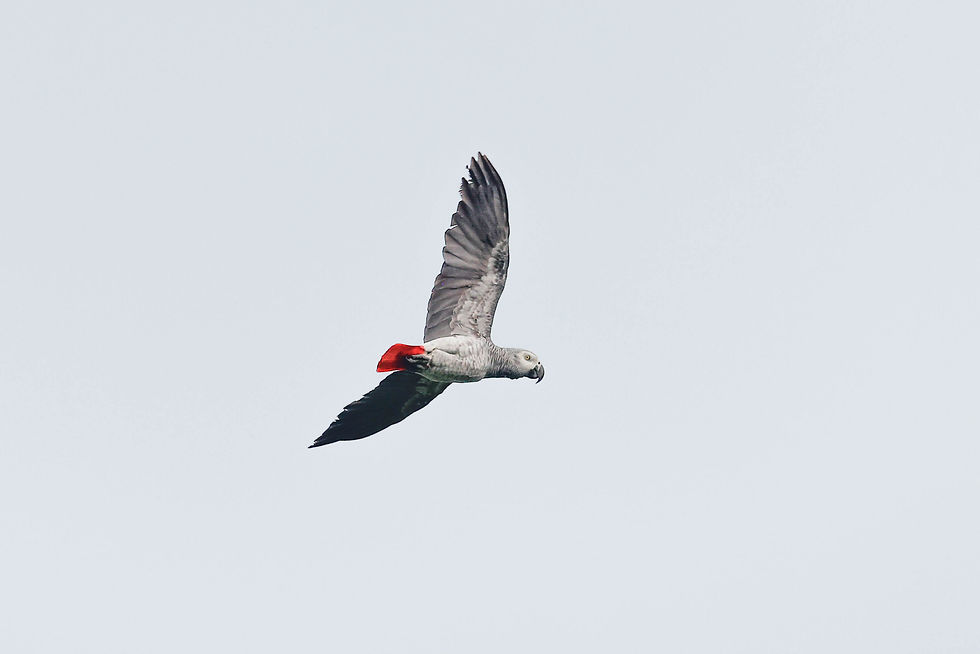
We carried on, exploring this seemingly vast network of bais called Mbouebe. Eventually, we got to an area where we could hear virtually nothing but African Grey Parrots calling and a small viewpoint at the edge of the next clearing allowed us to view various congregations of African greys perched in trees, vocalising enthusiastically, completely engrossed in their own affairs. The parrots also extract various minerals from the water in these bais which helps to settle their stomachs.
We headed back for the boat and while it had been a lengthy morning, we were still very much on the lookout. The morning had one more surprise in store for us. While taking an eye level shot of a malachite kingfisher at the river’s edge, something in a low-lying branch of a nearby tree caught our eye and we couldn’t believe what it was: an African palm civet. These (normally highly nocturnal) creatures superficially resemble cats and are usually very tricky to see even by night. This individual was just hanging out and allowed Hadley to get some great photos

In the afternoon, after a very hot and sweaty midday jog, we walked to a nearby river and located a group of hippo that were hanging out in a deeper part of the water. More and more little heads poked out of the water and they made a fair bit of noise as they realised they were being watched by a group of heavily perspiring humans. The humidity around the river in the late afternoon was intense and we quickly decided to call it a day.

The next morning it was time for a far more laid-back activity: we simply walked out to the river in front of our rooms, got in with all our lightweight clothes on and floated gently downstream for an hour and a half. It was an activity that allowed us to both literally and figuratively let go. The focus wasn’t at all on the destination or on seeing any wildlife along the way; it was simply on the joy of feeling the cool river water on our skin, listening to the sound of the river and the forest, and relaxing. Odzala lends itself extremely well to letting go and embracing one’s inner child and joy. Many of the activities allow you to be fully present in what you’re doing. It’s highly meditative. All members of our group were giddy throughout the entire activity.
In the afternoon, we drove through the savanna along the beginning of the Kamba Marathon route. Yes, there is a marathon that takes place here every year and a few members of our group (including Jomi) have already loosely decided to return to run the marathon in 2027. It’s a challenging trail run both in terms of terrain and of course due to the equatorial conditions. Funds and awareness are raised for African Parks, the non-profit that manages Odzala National Park in conjunction with the Congolese government. There is also a half marathon and a 10k option for those interested but less inclined for the full marathon distance (Hadley).

When we reached the end of the savanna, we got out of the vehicle and walked a short distance away from the road to a small mud wallow in the forest where a camera trap was hidden in a tree. Our guide exchanged the SD card, and we all chose an animal that we thought might have passed by the camera trap over the past few weeks. When we got back to the vehicle, our guide Joe pulled out the SD card and his laptop and we went through the photos and videos together. The abundance and diversity of wildlife that had used this completely unassuming mud wallow in the forest was astounding. A male leopard had walked past, a group of red-river hogs and their tiny striped hoglets had wallowed. Elephant bulls fighting, yellow backed duiker, a troop of western lowland gorilla and at last a troop of chimpanzees had also been here. Knowing that we had almost certainly walked past some of these elusive forest creatures over the past few weeks but not seen them was magical. The secrets of the forest make the forest what it is: mythical and mystical. Understanding that we will likely never see some of the forest residents is such a calming thought; there are just parts of our planet that should remain a mystery.
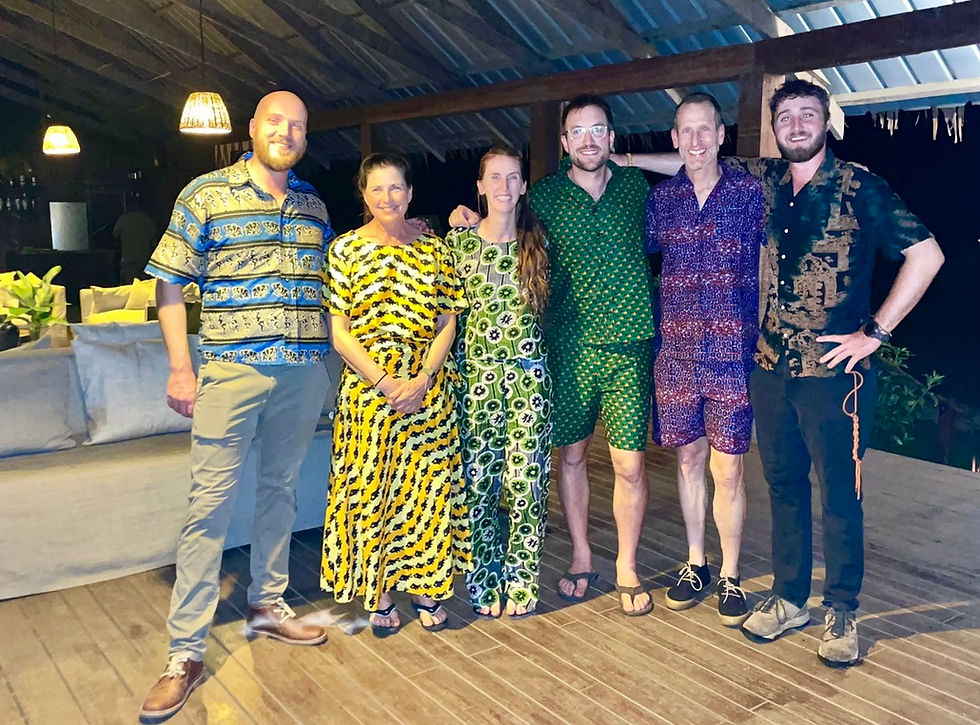
Our time at Odzala came to a close with a lovely communal dinner with the other guests at Mboko with all of us clad in our local fabric attire that the talented tailor had managed to complete for us.
We can’t wait to return to the Congo and to Odzala-Kokua National Park. We hope you enjoyed these three episodes. We will return with more episodes soon, as, from the Congo, we continued on with our travels to Ethiopia—another unique and completely different country and destination.


Comments